Rasa No. 2 — Raudra: Billboard Bachpan & the Business of Brilliance
A two months anniversary drop of Raudra — scorched report cards, childhoods sold by square foot, and the fire behind Pinky's sunglasses.

Two months ago, this journey began — a journey of stories, service, and self-leadership. What an incredible ride it’s been!
In just a few weeks, I’ve grown as a writer, creator, and community member, learning through every story and every connection.
These tales are my way of honoring this moment — and embodying a kind of leadership rooted in emotional fluency, cultural depth, and radical storytelling.
To celebrate this meaningful milestone, I’m thrilled to continue the heartfelt anniversary series.
Each month, a new story, a new rasa crafted with care and infused with the joy of this creative path we’re sharing. These tales are my way of honoring this moment and inviting you to join me in weaving the magic of this journey together.
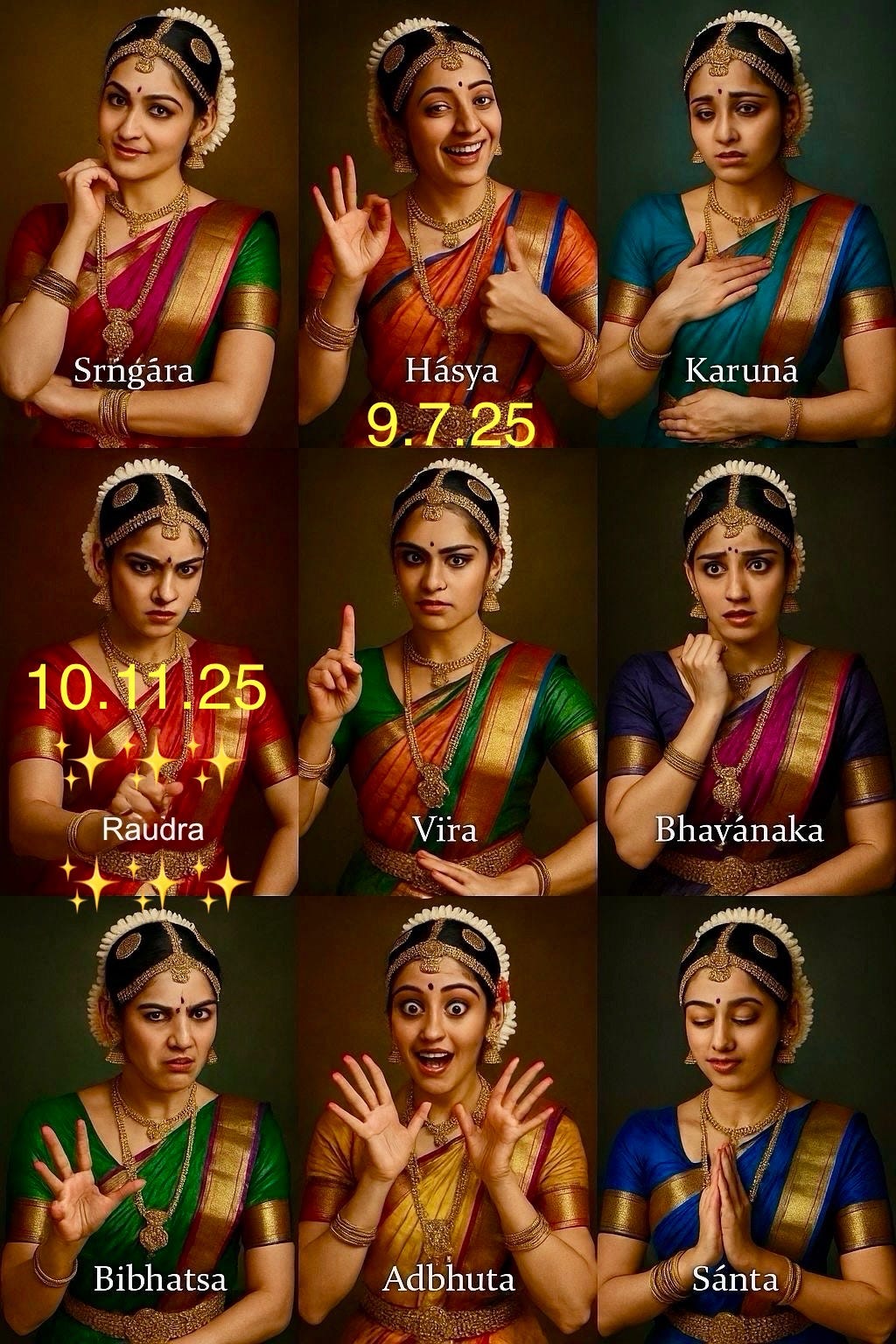
Here is the series reflecting, nine states of emotional empowerment called “Navarasa”.
‘Nava’ means nine, and in classical Indian aesthetics, ‘rasa’ refers to the emotional essence, the feeling a story leaves behind.
These are the navarasa, each evoking a distinct emotional state:
1. Śṛṅgāra – Love, beauty
2. Hāsya – Laughter, joy
3. Karuṇa – Compassion, pathos
4. Raudra – Anger, fury
5. Vīra – Heroism, courage
6. Bhayānaka – Fear, anxiety
7. Bībhatsa – Disgust, aversion
8. Adbhuta – Wonder, curiosity
9. Śānta – Peace, stillness
Here’s to a Navarasa journey every month with mood, memory, and magic of story-telling.
1. Śṛṅgāra/Shringār (Love)
Mood: Warm, tender, intoxicating
Memory: First crush under twilight skies
Magic: Story so velvety and rich with shared moments and whispered promises
2. Hāsya (Joy)
Mood: Lighthearted, sparkling, content
Memory: Laughter-filled evenings with friends
Magic: A bubbly burst of joy that tickles every rib in your body
3. Raudra (Anger)
Mood: Fiery, intense, bold
Memory: That passionate debate that changes everything
Magic: A robust inner fire that empowers transformation
4. Karuṇa (Compassion)
Mood: Gentle, soothing, healing
Memory: Comfort in a friend’s embrace during tough times
Magic: A smooth bridge of empathy and kindness, calming the soul
5. Bībhatsa (Disgust)
Mood: Earthy, grounding, cleansing
Memory: Overcoming something unpleasant and emerging stronger
Magic: A reminder of resilience and rebirth
6. Bhayānaka (Fear)
Mood: Dark, mysterious, insecure
Memory: That heart-racing pause before a leap of faith
Magic: A deep, complex self doubts that invites you to confront shadows and find courage
7. Vīra (Courage, Heroism)
Mood: Bold, spirited, empowering
Memory: Standing tall when it mattered most
Magic: A strong rush of determination that emboldens and energizes, a toast to bravery and self-determination
8. Adbhuta (Wonder, Surprise)
Mood: Curious, magical, fascinating
Memory: Discovering a secret garden for the first time
Magic: An innocent playfulness that awakens the senses and sparks awe and amazement
9. Śānta (Peace)
Mood: Calm, serene, restorative
Memory: Quiet moments at dawn, wrapped in stillness
Magic: A delicate tranquility that soothes the mind and invites deep calm
We all live in these rasas. Every moment. Every tale. Every turning point.
And so, each month, a story rooted in one rasa.
And now for this month’s Navarasa, we enter Raudra: the rasa of anger, fury, the righteous rage.
Not tantrums. Not noise.
But the slow-building fire that rises when injustice has been tolerated too long.
This isn’t the rage that destroys.
It’s the rage that awakens. That sharpens. That drives change.
And this time, Pinky isn’t laughing.
She’s looking up at billboards of children turned into advertisements,
and asking: Who benefits when we turn childhood into a competition?
Because sometimes, the most radical act of love
is refusing to stay silent.
Billboard Bachpan & the Business of Brilliance
Pinky was that annoying kind of smart; 98th percentile, sometimes 99th, never coached, never crammed.
She learned under tube light and pressure cooker whistles,
while Harsha taught her compound interest and independence at the same time.
No coaching class. No air-conditioned test series.
Just borrowed books, floor seating, and Harsha’s voice turning confusion into clarity.
Back then, the syllabus came with sev-ganthiya, not scan codes.
The only “mock test” was being quizzed mid-bite at the dinner plate.
And never once did her face appear on a billboard.
Which, at the time, felt ordinary.
But in hindsight? It was freedom.
She didn’t chase the spotlight.
And the spotlight didn’t chase her.
No billboards. No flex.
Just grit, quiet pride, and the confidence that comes from understanding, not outsourcing.
Fast forward to now.
She passes a flyover in any Indian city and the skyline shouts:
“Rank 3, Gujarat Zone. Batch of 2025. Dreams fulfilled at XYZ Tutorials™️.”
“Ranked 2nd in JEE!”
“Topper, All India NEET! 100% Selection. Enroll now.”
“Success = Us + You = Billboard!”
A row of awkwardly smiling kids holding up marks like Olympic medals.
Their faces, blown up larger than life.
Their names in bold.
Their future in font size 72.
Faces of children, 14 to 17; barely out of childhood; blown up in vinyl, flex hoardings larger than school play grounds.
Their eyes pixelated under fluorescent lights.
Their names public, their marks weaponized for marketing. Their futures copyrighted.
Behind every photo is a ₹3,00,000-a-year package,
a 6-day schedule,
and 12-hour study days designed not for learning, but for cracking.
India’s private coaching market is now worth ₹58,000 crore, and growing.
Some students are enrolled in coaching before they’ve cleared class 6.
Some cities have more coaching centres than public libraries.
And some kids? Have panic attacks before their first board exam.
Pinky adjusts her sunglasses at the red light and thinks:
“Isn’t this the same country where you need consent for a school magazine photo, but not for a child’s nervous smile on a 40-foot flex banner for a coaching class?”
Education, it seemed, wasn’t a right anymore.
It was a product with marketing targets.
Childhood became billboard equity.
Marks became hashtags.
Success became measurable in hoardings-per-mile.
And forget privacy! These billboards take up more space than actual playgrounds.
200 square feet of pressure.
No asterisk for anxiety.
No disclaimer for depression.
The billboard doesn’t show:
- The anxiety
- The fear of failure
- The kid who ranked 37th and now feels invisible
- The students who lose sleep, appetite, and eventually, themselves
- The parents who compare
- The children who break
She wonders:
How long will the education continue as a PR campaign?
When will learning stop being a performance metric?
When will childhood stop being sold like a product line?
And most of all,
Can someone put up a billboard of who they became five years after the result?
Pinky stayed unbothered for years… laughing, sipping chai, rolling her eyes.
But now, with stories of breakdowns, burnouts, and young lives lost under pressure piling up,
she can no longer just laugh.
She wants to ask:
Dear Policy makers,
What if we stop turning toppers into advertisements?
What if we invest in children’s well being and not just marketing?
What if we celebrate effort over outcome; and protected childhood, not profiting from it?
The theft of childhood didn’t always came announced.
It came quietly.
It was slow, normalized, glorified.
Children stopped being learners. They became outcomes.
Coaching centers promised “100% selection” while parents quietly shelled out EMIs.
20,000+ coaching institutes across India,
and a crisis no one wanted on the billboard.
I spent just one evening in Kota, sometime in ’96.
Back then, it felt like a town.
Now, it sounds like a pressure cooker.
And the hoardings?
They don’t show that pressure.
They show smiles. Trophies. AIR ranks.
No one prints the fear, the shame, the panic attacks,
or the children who whisper “I’m falling behind” before they know what falling means.
And the problem isn’t just one city.
It’s cultural. Systemic. National.
We’ve allowed education to become a ₹58,000 crore industry…
but failed to make emotional safety a classroom subject.
Pinky didn’t post her results anywhere.
She passed. Quietly. Then lived. Loudly.
She wants to ask, sincerely:
Dear Policy makers,
If Digital India can verify marks, can’t it also protect the minds that earn them?
Can we legislate limits on billboard exploitation?
Fund school counsellors like we fund coaching ads?
Can we measure growth without reducing children to scores?
Because this isn’t about banning ambition.
It’s about balancing it with compassion.
Not for rank.
Not for marketing.
But for mental well-being. For every child. For what they might become, beyond the percentile.
But let’s not get distracted by shiny solutions. It’s not in the clouds, it’s in the classrooms.
And no, Pinky doesn’t think AI will save the day.
Tech can make a timetable, maybe even write a poem; but it can’t hug a nervous 14-year-old after they fail a math test.
The problem isn’t that we don’t have innovation.
The problem is that we don’t have intention.
Not the kind that funds school libraries, or pays teachers on time.
Not the kind that believes a government school should be more than a building with peeling paint and unpaid electricity bills.
Pinky wants fewer apps, more chalk.
Fewer dashboards, more actual desks.
We don’t need to “disrupt education.”
We need to repair it.
- Strengthen public schools so every child learns, not just performs.
- Support local teachers and mentors instead of franchised “edu-preneurs.”
- Teach curiosity, not just cracking.
- Make schools places of growth, not just GPA farms.
Because not everything can be upskilled. Some things must be upheld.
And behind every reform is a student, just like Pinky, who just needed a fair chance.
Pinky never made it to a coaching center.
But she did make it to peace.
And she believes every student deserves that too.
Not for rank.
Not for a flex.
But for life.
Her voice?
Hot, clear, and no longer quiet.
Harsha once said, folding laundry without missing a beat:
“Marks come and go, beta. But how you learn to think, no one can take that away.”
And Pinky?
She’s still thinking.
Louder now.
P.S. This story comes from deep respect.
I share it not to provoke, but to propose. I hold full regard for those in public office, including sitting Prime Minister of India. My intention is visibility, not virality — dialogue, not division. If this resonates, may it invite thoughtful reflection, not reactive noise.
#EducationNotExploitation
#RaudraRasa
#BillboardBachpan
#EveryChildDeservesBetter #MentalHealthMatters #EducationReform
#PolicyWithPurpose
#SubstackWriters
#PinkyDiaries #NavarasaSeries
#OneGirlTwelveHouses
I wish more of these topics you highlighted in this story are discussed amongst parents, leaders, influencers & politicians. This is the only way towards world prosperity & peace for everyone!!!
Keep writing, ✍️ keep inspiring
Thank you